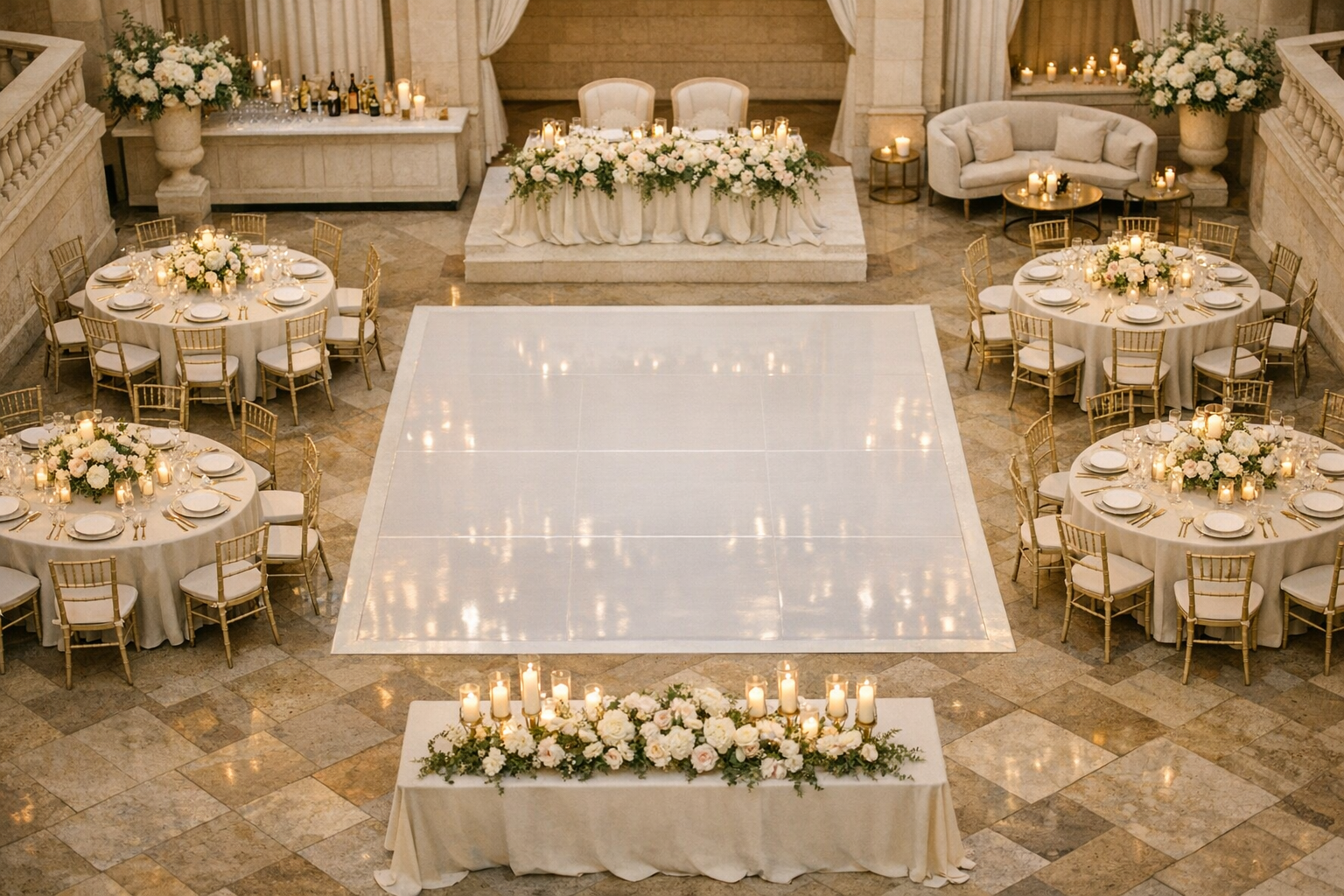
The best wedding reception layout ideas start with guest flow, not aesthetics. From traditional round tables to hybrid lounge setups, this guide covers every floor plan style with specific advice for Atlanta venues, guest counts, and design decisions that actually matter.
The Best Wedding Reception Layout Ideas Start With How Your Guests Will Move
The most effective wedding reception layout ideas share one thing in common: they're designed around guest experience first, aesthetics second. A beautiful room that forces guests to squeeze past the DJ booth to reach the bar — or leaves elderly family members seated half a football field from the dance floor — will undermine even the most stunning décor. Before you choose between banquet rounds, long harvest tables, or a cocktail-style setup, map how people will actually move through your space. That single decision shapes everything else: where your sweetheart table lands, how your floral centerpieces get scaled, where your photographers position themselves, and how loud the band needs to play to fill the room without overwhelming table conversation.
The Four Core Reception Floor Plan Styles
Atlanta venues range from intimate Inman Park lofts to sprawling Buckhead ballrooms, so there's no one-size-fits-all approach. These four layouts cover the majority of what couples actually book:
1. Traditional Round Tables (Banquet Rounds)
Round tables seating 8–10 guests remain the most popular wedding reception layout in Atlanta for good reason. They encourage conversation within each table cluster, give photographers clear sightlines to every face during toasts, and scale efficiently in ballrooms from 80 to 400 guests. The standard formula: allow 12–14 square feet per seated guest, then add a separate dance floor (typically 2–3 square feet per expected dancer) and buffer zones for service aisles — at least 5 feet between table edges for servers with trays.
Best for: Formal receptions, larger guest counts, venues with rectangular or square footprints like hotel ballrooms.
2. Long Harvest or Farm Tables
Rectangular harvest tables have dominated Atlanta's modern wedding scene for the past several years, particularly in venues with exposed brick or industrial-chic bones. They photograph beautifully — long, dramatic runners of greenery and candles create images that read like editorial spreads. The tradeoff is guest flow: long tables require more aisle space and can isolate guests at the ends. If you're considering this style, cap table length at 8 feet and plan for at least 24 inches of place setting space per guest.
Best for: Garden weddings, warehouse venues, and couples prioritizing a lush, overflowing tablescape aesthetic.
3. Cocktail-Style or Lounge Reception
Fully cocktail receptions eliminate assigned seating and replace traditional tables with high-tops, lounge furniture clusters, and food stations. This layout encourages mingling and works especially well for couples with a younger, more social guest list. The critical planning note: even at cocktail receptions, you'll want some low-seated lounge areas (sofas, armchairs) for older guests and a clear flow path between the bar, food stations, and entertainment focal point.
Best for: Couples with 80–150 guests, art gallery venues, rooftop receptions, or events with a distinctly social atmosphere.
4. Hybrid Layout (Seated + Lounge Zones)
The hybrid layout is arguably the most sophisticated — and the most common choice for couples working with an experienced Atlanta event designer. A portion of the room holds traditional seated dinner tables while a dedicated lounge zone (typically near the dance floor perimeter) offers sofas, ottomans, and coffee tables for guests who want to keep the evening going without standing the entire time. This layout rewards thoughtful spatial planning but creates a genuinely elevated experience when executed well.
Key Zones Every Reception Floor Plan Needs
Regardless of which table style you choose, every wedding reception floor plan should deliberately account for these zones:
- Entry and escort card display: Allow enough space that arriving guests don't bottleneck. A foyer or pre-function hallway is ideal; if you're working within one room, position this near the entrance with a natural flow direction.
- Bar placement: Never position the bar directly at the entrance — it creates instant congestion. Place it to the side or rear of the room with a clear path from the entry point. For 150+ guests, plan on at least two bar stations.
- Dance floor: Industry standard is roughly 3 square feet per dancer, assuming about 50% of guests will dance at peak. For 150 guests, that's a 15x15 foot minimum. Surround the dance floor with tables rather than pushing it to a corner — guests stay engaged when they can watch from their seats.
- Sweetheart or head table: This should be the visual anchor of the room — centered on a focal wall, elevated if the room allows, and styled to draw the eye. Consider how your photographer and videographer will capture it; avoid placing it directly in front of a window unless you're shooting in evening light.
- Catering and service lanes: Work directly with your venue's catering team to ensure kitchen access corridors are protected. A 6-foot service lane from kitchen doors to the room perimeter is standard.
- Photo and video positioning: This is often overlooked until it's too late. Teams like TRD Media Grp and Rocheal Photography Group will work with your layout in advance — share your floor plan during the planning process so they can identify ideal positions for first dance coverage, cake cutting angles, and ambient reception shots.
Atlanta-Specific Venue Considerations
Atlanta's most beloved reception venues each come with their own spatial quirks. The Atlanta History Center in Buckhead offers seven distinct indoor and outdoor venue configurations — from the Swan House lawn to the Grand Overlook ballroom — each requiring a completely different approach to layout and flow. Couples who've tried to force a cookie-cutter floor plan into the Swan House have invariably struggled; the curved architecture and garden access points demand a custom approach.
Similarly, many of Atlanta's popular warehouse and loft venues in areas like Castleberry Hill, West Midtown, and Poncey-Highland offer raw square footage but minimal infrastructure. That freedom is exciting, but it also means you're responsible for mapping every element — power access for your band or DJ, load-in paths for your rental furniture, HVAC coverage zones — from scratch.
If you're not working with a full-service event designer, consider at minimum hiring a day-of coordinator who has worked in your specific venue before. Their spatial familiarity alone is worth the investment.
How Décor Influences Your Floor Plan (and Vice Versa)
Your design choices and your floor plan are in constant conversation. Tall floral installations look spectacular in photographs but can visually shrink a room and block sightlines — something a team like TRD Media Grp Events and Design, which specializes in premium drapery and room transformation, accounts for when planning vertical elements. Drapery that defines zones (framing the dance floor, creating an intimate sweetheart table alcove) can actually solve layout problems by establishing visual boundaries without physical walls.
Lighting is the other major variable. Up-lighting around the room perimeter can make a cavernous ballroom feel intimate. String lights or bistro lights dropped low over dining tables reduce the perceived ceiling height and create warmth. But all of this needs to be coordinated with your floor plan before any equipment is ordered — lighting rigs require anchor points, and those anchor points affect where your tables can go.
Sample Floor Plan for a 150-Guest Atlanta Reception
Here's a practical starting point for a 150-guest reception in a 4,500–5,500 square foot ballroom:
- Entry zone (300–400 sq ft): Escort card display, welcome signage, small floral moment
- Dining area (2,200 sq ft): 15 rounds of 10, 12–14 sq ft per guest, 5-ft service aisles
- Dance floor (600 sq ft — 24x25 ft): Centered in the room, surrounded by tables on three sides
- Bar stations (2 bars, 150 sq ft each): One on each side wall, offset from the entrance
- Sweetheart table (200 sq ft including backdrop): On the focal wall facing the dance floor
- Lounge zone (400 sq ft): Two to three seating clusters near the dance floor perimeter
- Cake and dessert station (200 sq ft): Visible but not in the primary traffic path
- Service corridor (300 sq ft): Protected lane from kitchen access
Where to Start: Building Your Floor Plan
Most Atlanta venues will provide a CAD floor plan or at minimum a measured room diagram when you book. Start there. Plug in your table configuration using free tools like AllSeated or Social Tables (both offer drag-and-drop venue layouts), then layer in your zones in this order: dance floor → sweetheart table → bar stations → dining tables → lounge → service lanes. Add décor and lighting after the functional layout is locked.
If you want expert eyes on your plan before you finalize vendor contracts, The Grand Moment connects Atlanta couples with vetted designers, florists, and venue specialists who review layouts as part of the planning process — not as an afterthought.
Plan Your Atlanta Reception With Confidence
A well-designed floor plan is the invisible foundation of a seamless reception. Your guests will never see the spreadsheet or the CAD drawing — but they'll feel the difference between a room that flows and one that doesn't. The Grand Moment's platform gives Atlanta couples access to the designers, florists, photographers, and venue experts who turn floor plans into finished rooms worth remembering.
Ready to start building your vision? Tell us about your event and we'll match you with the right team for your venue, guest count, and aesthetic — no guesswork required.
Your Vision Awaits
Describe Your Dream Event
Get matched with Atlanta vendors who specialize in your exact style, budget, and vision.
Get Started