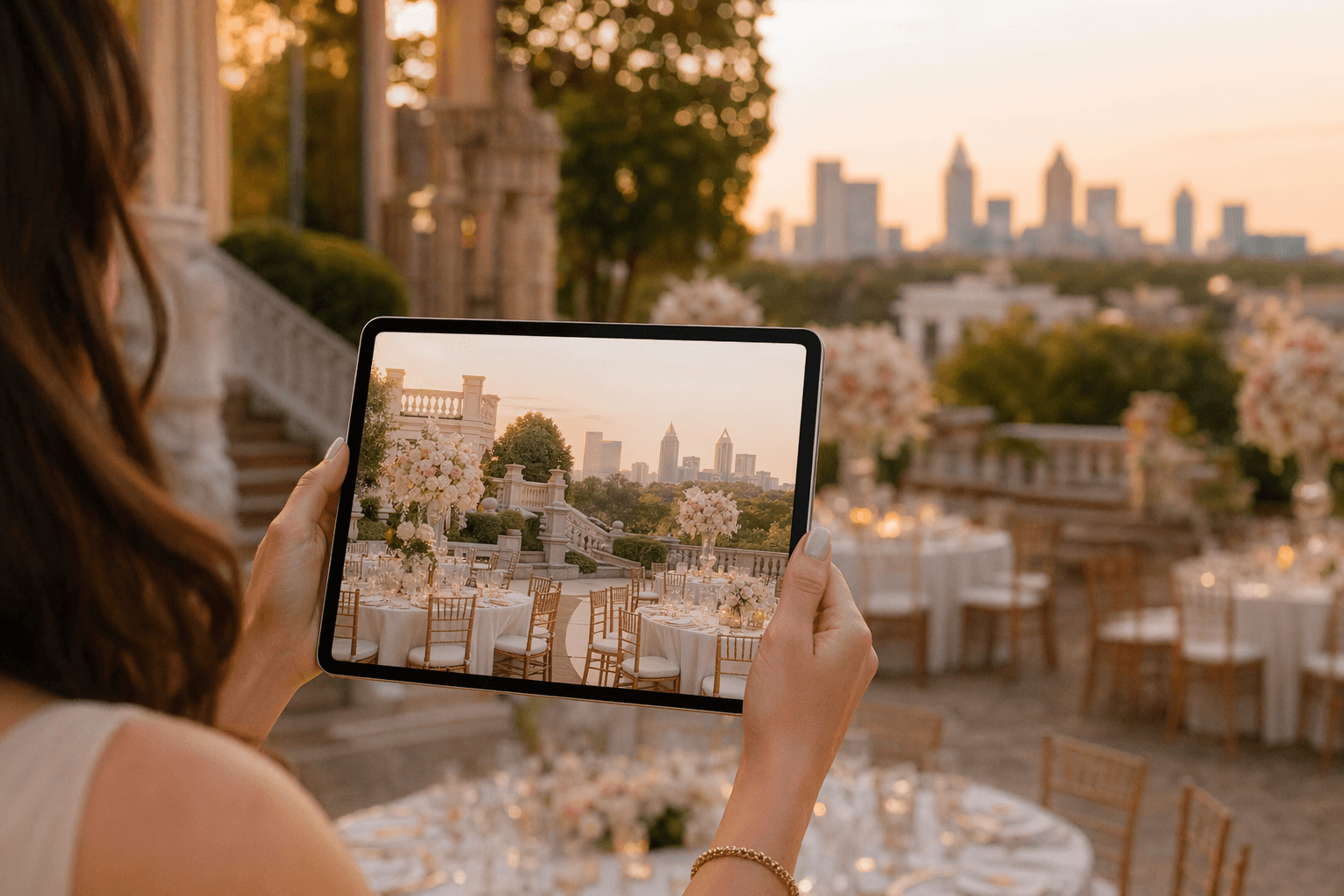
AI wedding design went from experimental to mainstream in 2026. This is a practitioner's guide to the current state — what the technology can and can't do, which trends matter, and how couples and vendors should actually use it.
We're writing this in April 2026, a few weeks into running The Grand Moment. The AI wedding design space moved faster over the past year than most people in the industry expected — what was a curiosity at conferences two years ago is now a tool most couples starting their planning have at least tried. Here's where the space actually stands, what's working, what's overhyped, and what we expect next — written from the perspective of a founder team building inside it.
What AI wedding design now includes
When we say "AI wedding design" in 2026, we mean a cluster of tools and practices:
- AI vision generation — render a photograph-style image of your event based on your inputs. This is what most couples think of first.
- AI vendor matching — match couples to vendors based on style fit, budget, availability, and quality signals rather than keyword search.
- AI-assisted planning — timeline generation, seating chart suggestions, guest-list management with smart recommendations.
- AI content creation — mood boards, proposals, stylized social posts for vendors.
- AI walkthrough video — short cinematic video passes through rendered spaces, pioneered by a few platforms in late 2025 and now expected on premium tools.
Not all of these are equally mature. Image generation is remarkably good. Vendor matching is solid when the underlying vendor data is rich. Planning assistance is uneven — great for timelines, mediocre for seating charts. Content creation for vendors is a mixed bag. Walkthrough video is early but improving fast.
What actually changed in 2025–2026
Image quality crossed the uncanny valley
In 2024, AI-generated wedding renders were recognizable as AI — the flowers looked a little off, the perspectives didn't quite work, the lighting was flat. By late 2025, a new wave of image-edit models brought the output into the uncanny-valley-clearing zone: realistic enough that most viewers can't distinguish a good render from a real event photo. We've had couples ask if a render was their actual wedding. That's the milestone that moved AI wedding design from "party trick" to "useful tool."
Occasion awareness matured
Early AI wedding tools rendered every event as a wedding. A corporate event looked like a wedding reception with floral arches; a birthday came back with ceremony aisles. By 2026, the better tools handle occasion-specific rendering — a corporate gala looks like a corporate gala, a birthday looks like a birthday. This seems minor but it's huge for non-wedding events that previously got weddingfied by default.
Video became accessible
Generating a 5–10 second walkthrough video of a rendered space used to cost $5–20 per render and take 5–10 minutes. By 2026, video models got fast and cheap enough that better platforms generate video as part of the default vision output. It's dramatically more emotional than a still image.
Vendor matching finally got good
Early "AI vendor matching" was basically keyword search with a better UI. By 2026, real matching systems use style embeddings, portfolio analysis, response-rate signals, and quality flywheels to produce recommendations that genuinely fit. The gap between "vendor directory" and "vendor matching" is now meaningful.
What's still limited
AI can't actually execute your wedding
An AI vision doesn't source flowers, pay vendors, or set up tables. The gap between "I have a rendered vision" and "I have an executed event" is 100% human work — vendors, planners, you, your partner. AI compresses the front end of the process (deciding what you want); it doesn't touch the back end (making it happen).
Personalization to couple identity is still shallow
Most AI wedding tools render aesthetic but not identity. If you want your event to feel specifically like your personalities — cultural traditions, inside jokes, specific meaningful touches — the AI won't surface those. That's still planner work and couple work.
Specific vendors can't be previewed
An AI vision shows you a style of florals, not your actual florist's specific arrangements. If you want to preview what a specific vendor would produce for your event, you still need to look at their portfolio and imagination. AI vision is generic-style-specific, not vendor-specific.
Date and season awareness is inconsistent
If you tell an AI you're getting married in December, good tools will render appropriate seasonal florals and lighting. Less good tools will render June florals in December settings. This is easy to check; if the tool doesn't take date as an input, the output won't be seasonal.
Trends that are actually real
- Couples arriving at first vendor meetings with AI renders. This is now standard at The Grand Moment vendors' inquiries. Couples lead with visuals, not abstract description. Vendors love it.
- Vendors using AI for proposal content. Photographers in our network are generating mood-board style renders to show couples during discovery calls. It's faster than traditional mood-boarding.
- AI-matched micro-weddings. Couples using AI matching to find specific vendors for intimate events (under 40 guests) where a curated shortlist matters more than national breadth.
- Occasion-flexible tools. The same AI vision system serving weddings, birthdays, corporate events. This unifies what used to be fragmented single-purpose tools.
Trends that are overhyped
- "AI-generated wedding speeches." Some platforms sell this. Almost universally mediocre output. Write your own speech.
- "AI wedding dress design." Real bespoke gowns aren't designed by AI — they're designed by humans with AI as a sketch tool. The "AI wedding dress" pitch overpromises.
- "Full AI wedding planning." A fully autonomous AI that plans your entire wedding without a human does not exist in 2026 and won't in 2028. Human coordination is not the bottleneck the AI hype implies.
How couples should approach AI wedding design
- Use free tools first. AI wedding vision is free at The Grand Moment and similar platforms. See if the technology is useful to you before paying anywhere.
- Generate early. The best time to generate an AI vision is before your first vendor conversation. It orients all subsequent conversations.
- Share liberally. Send your vision to your planner, key vendors, your partner, your parents if relevant. It's a shared reference that dramatically reduces miscommunication.
- Don't overspecify. Use the vision as direction, not literal spec. Good vendors will bring creative contribution; they can't if you've locked them into reproducing an AI render pixel-for-pixel.
How vendors should approach AI wedding design
- Expect couples to arrive with visions. The ones who use AI will send you one before the first meeting. Treat it as a style direction, not a literal ask.
- Use AI for your own content. Mood boards, proposals, social content — AI tools save significant time on low-stakes visual work.
- Be on AI-matching platforms. If AI matching is where couples increasingly find vendors, being on the matching platforms matters. Apply to The Grand Moment if you're in Atlanta.
- Don't try to recreate AI renders literally. Set expectations with couples that the real event will differ — same style, different specifics.
What's next
Our honest predictions for 2026–2027:
- Real-time AI design collaboration. Couple and planner sitting together, tweaking a vision live, seeing changes render in seconds. Already starting in early tools.
- Vendor-specific rendering. "Show me what THIS florist would do for my wedding" based on their historical portfolio. Technically feasible; likely 2027.
- Integrated planning AI. The AI vision becomes a planning agent — budgeting, scheduling, vendor coordination layered on top of the visual output. Harder problem but emerging.
- Continued price compression. What cost $5 in compute per render in 2023 costs cents in 2026. That trend continues. AI wedding design will keep getting more accessible.
If you're planning a wedding in 2026, AI wedding design is no longer optional to consider — it's become part of the standard toolkit. You don't have to use it, but the couples who do are planning more confidently in less time.
Our take: start with a free AI vision. Try The Grand Moment. If the technology is useful to you, keep using it. If it's not, you've lost 60 seconds.
Your Vision Awaits
Describe Your Dream Event
Get matched with vendors who specialize in your exact style, budget, and vision.
Get Matched